Transforming your email marketing skills into a powerful tool for crafting effective campaigns requires a strategic blend of audience understanding, data analysis, and design mastery. This guide delves into the core elements of successful email marketing, providing actionable steps to improve your open rates, click-through rates, and ultimately, your conversion rates. We’ll explore how to personalize your messaging, leverage data-driven insights, and create visually appealing emails that resonate with your audience.
From segmenting your audience to optimize messaging and A/B testing subject lines, to mastering email design and ensuring deliverability, this comprehensive guide provides a structured approach to elevate your email marketing game. We’ll uncover the secrets to creating compelling email content that not only captures attention but also drives meaningful engagement and achieves your campaign objectives.
Understanding Your Audience and Refining Your Messaging

Effective email marketing hinges on understanding your audience and crafting compelling messages that resonate with their specific needs and interests. Generic emails rarely achieve high open and click-through rates. By segmenting your audience and tailoring your messaging, you can significantly improve campaign performance.
Defining Audience Segments and Subject Lines
To effectively target your audience, consider segmenting your email list into distinct groups based on shared characteristics. This allows for personalized messaging that increases engagement. Let’s examine three common segments:
- Segment 1: New Subscribers: These are individuals who have recently signed up for your email list. They are likely curious about your brand but may not be fully invested. Subject line example: “Welcome to [Your Brand]! Here’s Your Exclusive Gift.”
- Segment 2: Existing Customers: This segment comprises individuals who have previously purchased from you. They are more likely to be interested in promotions, new product launches, or loyalty programs. Subject line example: “Special Offer Just for You: [Discount Percentage] Off Your Next Purchase.”
- Segment 3: Inactive Subscribers: These are individuals who haven’t engaged with your emails in a while. A re-engagement campaign might be necessary to win them back. Subject line example: “We Miss You! Catch Up on What You’ve Missed at [Your Brand]”.
Email Copy Examples for Different Personas
Consider the following email copy examples tailored to the personas described above:
- New Subscriber: “Welcome to [Your Brand]! We’re thrilled to have you join our community. As a special thank you, here’s a [Discount Percentage]% discount on your first order. Click here to browse our collection: [Link to website].”
- Existing Customer: “Hi [Customer Name], We’ve got something special for you! As a valued customer, you can enjoy [Discount Percentage]% off your next purchase of [Product Category]. This offer is valid until [Date]. Shop now: [Link to website].”
- Inactive Subscriber: “Hi [Customer Name], We noticed you haven’t been receiving our emails lately. We’re always working on bringing you the best deals and information. Check out our latest blog post on [Relevant Topic]: [Link to blog post]. We hope to see you back soon!”
Strategies for A/B Testing Subject Lines and Email Body Content
A/B testing is crucial for optimizing email performance. This involves sending variations of your email subject lines and body content to different segments of your audience and analyzing which performs better. For example, you might test two different subject lines against each other, measuring open rates. Similarly, you could test different calls to action or email layouts.
The results inform future email campaigns, allowing for continuous improvement. Tools like Mailchimp, Constant Contact, or even custom solutions can facilitate this process.
Analyzing Call-to-Action (CTA) Button Effectiveness
Tracking the effectiveness of your CTAs is essential for understanding what resonates with your audience. Below is a sample table illustrating CTA performance across different campaigns. Remember that real-world data will vary significantly based on your industry, audience, and campaign goals.
| CTA Button Text | Campaign Type | Click-Through Rate | Conversion Rate |
|---|---|---|---|
| Shop Now | Promotional Email | 15% | 5% |
| Learn More | Informational Email | 10% | 2% |
| Download Now | Lead Magnet Email | 20% | 8% |
| Book a Consultation | Service-Oriented Email | 8% | 3% |
Leveraging Data and Analytics for Improved Campaign Performance

Effective email marketing relies heavily on understanding and utilizing data. By tracking key metrics and analyzing campaign performance, you can refine your strategies, personalize your messaging, and ultimately achieve a higher return on investment. This section will explore how to leverage data and analytics to significantly improve your email campaign results.
Key Email Marketing Metrics
Monitoring the right metrics provides crucial insights into campaign effectiveness. Understanding these key indicators allows for data-driven decisions to optimize future campaigns. Some essential metrics include open rates, click-through rates, conversion rates, bounce rates, and unsubscribe rates. Open rate indicates the percentage of recipients who opened your email; click-through rate shows the percentage who clicked a link within the email; conversion rate measures the percentage who completed a desired action (e.g., purchase, signup); bounce rate reflects the percentage of emails that weren’t delivered; and unsubscribe rate shows the percentage of recipients who opted out.
Analyzing these metrics in conjunction provides a comprehensive picture of campaign success.
Using Email Analytics to Identify Areas for Improvement
Email analytics platforms provide detailed reports on various aspects of your campaigns. By examining these reports, you can pinpoint areas needing improvement. For example, a low open rate might suggest issues with your subject line or sender reputation. A low click-through rate could indicate unclear calls to action or irrelevant content. High bounce rates might signal problems with your email list hygiene, such as outdated or invalid email addresses.
Analyzing these patterns helps identify specific weaknesses and guide adjustments to improve future campaign performance. A consistent monitoring process allows for ongoing refinement and optimization.
Segmenting Your Email List Based on User Behavior and Engagement Data
Segmenting your email list allows for targeted messaging, leading to higher engagement and conversion rates. You can segment based on various data points, including demographics, purchase history, website activity, and email engagement. For example, you could segment users based on their past purchases, sending targeted promotions for similar products. Alternatively, you could segment based on website activity, sending emails to users who viewed specific products but didn’t make a purchase.
This tailored approach significantly improves campaign relevance and effectiveness.
Workflow for Analyzing Email Campaign Performance and Making Data-Driven Decisions
Imagine a flowchart: First, you
- Launch an email campaign*. Next, you
- Collect data* on open rates, click-through rates, conversions, bounce rates, and unsubscribes. Then, you
- Analyze the data* to identify trends and patterns. This analysis leads to
- Identifying areas for improvement*, such as refining subject lines, improving content relevance, or segmenting your audience more effectively. Finally, you
- Implement changes* based on your findings and
- Launch a revised campaign*, repeating the cycle for continuous improvement. This iterative process ensures that your email marketing efforts are constantly evolving and optimizing based on real-world performance data. For example, if your open rates are consistently low, you might A/B test different subject lines to find one that resonates better with your audience.
Mastering Email Design and Deliverability
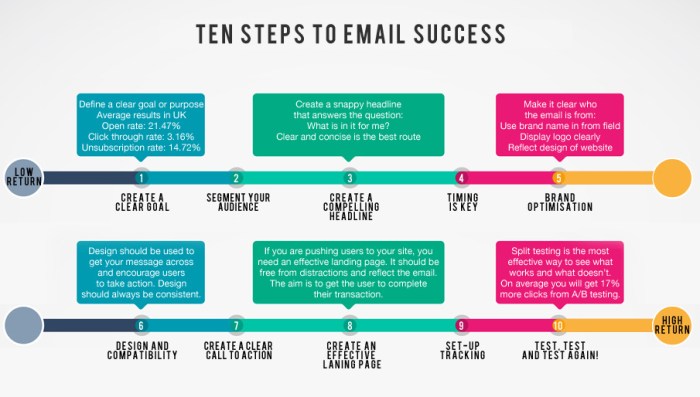
Effective email marketing hinges on both captivating design and reliable delivery. A beautifully crafted email is useless if it lands in the spam folder. This section will explore best practices for creating visually appealing and responsive emails, compare popular email marketing platforms, and provide a step-by-step guide to improving email deliverability.
Visually Appealing and Responsive Email Templates
Creating visually appealing emails requires a balance of aesthetics and functionality. A clean layout, consistent branding, and high-quality images are crucial. Responsiveness ensures your email renders correctly across various devices (desktops, tablets, smartphones). This is achieved using responsive design techniques, often employing fluid grids and flexible images that adjust to screen size. Consider using a modular design approach to create reusable components for faster template creation and consistency across campaigns.
Avoid excessive use of images, large file sizes, and complex layouts that may hinder rendering and increase load times. Testing across different email clients and devices is vital to ensure optimal display.
Comparison of Email Marketing Platforms
Several email marketing platforms offer varying features and functionalities. Popular choices include Mailchimp, Constant Contact, Sendinblue, and ActiveCampaign. Mailchimp is known for its user-friendly interface and affordability, ideal for smaller businesses. Constant Contact provides robust features suitable for larger organizations, while Sendinblue offers a more comprehensive suite including SMS marketing. ActiveCampaign stands out with its advanced automation capabilities.
The best platform depends on your specific needs, budget, and technical expertise. Factors to consider when choosing a platform include the number of subscribers, email sending limits, automation capabilities, analytics dashboards, and integration with other marketing tools.
Improving Email Deliverability and Avoiding Spam Filters
High email deliverability ensures your messages reach the inbox, not the spam folder. This requires adhering to best practices for email authentication (SPF, DKIM, DMARC), maintaining a clean email list (removing inactive or invalid addresses), and crafting compelling subject lines that avoid spam trigger words. Regularly monitoring your sender reputation and addressing any bounce backs promptly is also crucial.
Using a reputable email marketing platform that adheres to industry best practices helps significantly. Building trust with your subscribers through consistent engagement and valuable content is equally important. Avoid using excessive HTML, overly promotional subject lines, and hidden text. A dedicated IP address can also improve your deliverability.
Crafting Compelling Email Content That Encourages Action
Effective email content should be engaging, concise, and encourage recipients to take action. Storytelling techniques can create a connection with your audience and increase engagement. For example, an email about a new product could begin with a personal anecdote about the problem the product solves, highlighting the journey of its development and the benefits for the reader. Include a clear call to action (CTA) with a prominent button or link, making it easy for recipients to respond.
A/B testing different subject lines, content, and CTAs can help optimize campaign performance. Examples of engaging email content might include personalized recommendations, exclusive offers, or behind-the-scenes glimpses into your company culture. Always prioritize providing value to your subscribers.
Ending Remarks
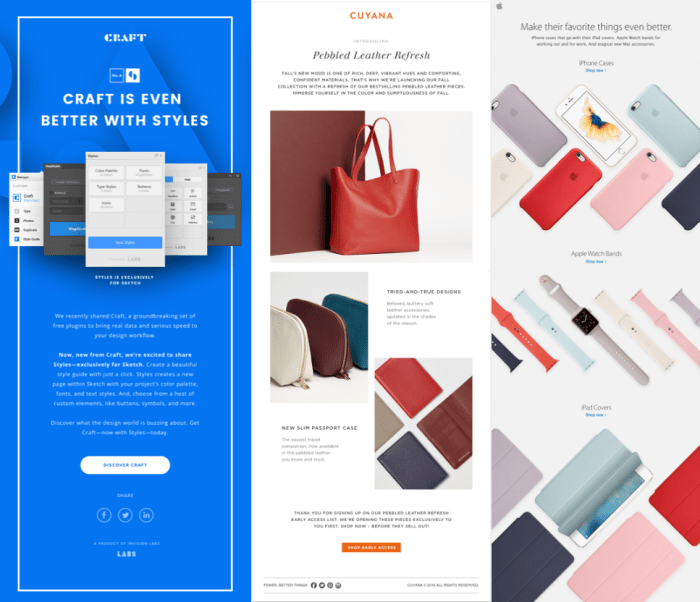
By implementing the strategies Artikeld in this guide, you can significantly improve your email marketing effectiveness. Remember, the key lies in understanding your audience, leveraging data to refine your approach, and crafting visually appealing and engaging emails. Continuous learning and adaptation are crucial in this ever-evolving landscape, so keep experimenting and analyzing your results to continuously optimize your campaigns for maximum impact.