In today’s world, bombarded by information from countless sources, the ability to critically analyze what we encounter is paramount. Developing strong critical thinking skills isn’t just about identifying misinformation; it’s about cultivating a nuanced understanding of how information is presented, the biases that shape it, and the methods used to persuade. This guide provides a practical framework for enhancing your critical thinking abilities, enabling you to navigate the complex information landscape with greater confidence and discernment.
We will explore techniques to identify cognitive biases and logical fallacies, evaluate the credibility of sources, and construct well-supported arguments. By mastering these skills, you’ll be better equipped to form informed opinions, make sound judgments, and engage in productive discussions on a wide range of topics. This journey will empower you to become a more informed and effective thinker.
Identifying Cognitive Biases and Fallacies

Developing strong critical thinking skills necessitates understanding and mitigating the influence of cognitive biases and logical fallacies. These mental shortcuts and flawed reasoning patterns can significantly distort our perception of information, leading to inaccurate conclusions and poor decision-making. By learning to recognize these biases and fallacies, we can improve our ability to analyze information objectively and form well-reasoned judgments.
Common Cognitive Biases
Several cognitive biases frequently hinder objective information analysis. These biases are systematic patterns of deviation from norm or rationality in judgment. Understanding their mechanisms is crucial for improving critical thinking.Confirmation bias, for example, is the tendency to search for, interpret, favor, and recall information that confirms or supports one’s prior beliefs or values. This bias can lead to a skewed understanding of a topic, as individuals may selectively ignore or downplay evidence that contradicts their existing viewpoints.
Another common bias is the availability heuristic, where individuals overestimate the likelihood of events that are easily recalled, often due to their vividness or recent occurrence. This can lead to inaccurate risk assessments and flawed predictions. The anchoring bias refers to the tendency to rely too heavily on the first piece of information offered (the “anchor”) when making decisions.
This initial piece of information can unduly influence subsequent judgments, even if it is irrelevant or inaccurate. Finally, the bandwagon effect describes the tendency to adopt beliefs and behaviors because they are popular or widely accepted. This can lead to a lack of independent thought and critical evaluation.
Confirmation Bias and Information Analysis
Confirmation bias significantly impacts information analysis by creating a filter through which individuals process information. For instance, someone who believes climate change is not a serious threat might selectively read articles and studies that downplay its effects while ignoring or dismissing those that highlight its dangers. This selective exposure reinforces their pre-existing belief, preventing them from developing a balanced and accurate understanding of the issue.
The result is a distorted perception of reality, hindering the ability to make informed decisions based on a comprehensive assessment of the evidence. This highlights the importance of actively seeking out diverse perspectives and critically evaluating information from multiple sources to counteract confirmation bias.
Identifying Logical Fallacies
Logical fallacies are flaws in reasoning that render an argument invalid. Recognizing these fallacies is essential for evaluating the strength and validity of arguments presented in various contexts. One common fallacy is thead hominem* attack, which involves attacking the person making the argument rather than addressing the argument itself. Another is the straw man fallacy, where someone misrepresents their opponent’s argument to make it easier to refute.
The appeal to authority fallacy involves accepting a claim as true simply because an authority figure said so, without further evidence. The false dilemma fallacy presents only two options when more exist, forcing a choice between extremes. Finally, the slippery slope fallacy argues that a particular action will inevitably lead to a series of negative consequences without sufficient evidence.
Types of Cognitive Biases and Their Effects
| Bias Name | Description | Example | Mitigation Strategy |
|---|---|---|---|
| Confirmation Bias | Seeking out information that confirms pre-existing beliefs and ignoring contradictory evidence. | A person who believes vaccines are harmful only reads articles supporting that view and ignores studies showing their safety and effectiveness. | Actively seek out diverse perspectives and evaluate information from multiple sources critically. |
| Availability Heuristic | Overestimating the likelihood of events that are easily recalled due to their vividness or recent occurrence. | After seeing news reports about shark attacks, someone might overestimate the risk of shark attacks while swimming. | Consider statistical data and base judgments on objective probabilities rather than anecdotal evidence. |
| Anchoring Bias | Over-reliance on the first piece of information received when making decisions. | A negotiator starts with a high initial offer, influencing the subsequent negotiations even if the initial offer is unrealistic. | Consider multiple perspectives and avoid being overly influenced by initial information. |
| Bandwagon Effect | Adopting beliefs and behaviors because they are popular or widely accepted. | Following a trend or fashion simply because it’s popular, without considering personal preferences or values. | Develop independent thinking skills and resist the pressure to conform to popular opinion. |
Enhancing Information Evaluation Skills
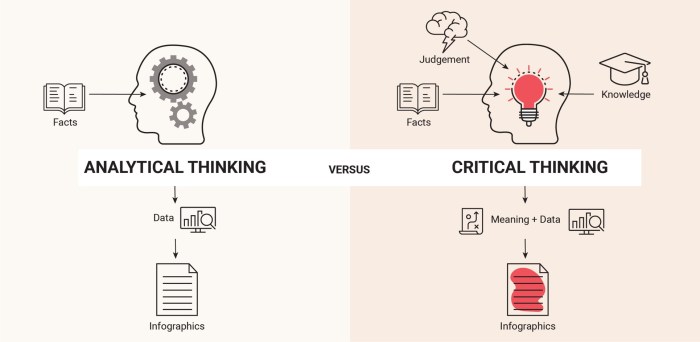
Developing strong information evaluation skills is crucial in today’s information-saturated world. The ability to critically assess the credibility of sources and detect misinformation is essential for informed decision-making and responsible citizenship. This section will explore methods for enhancing these skills, focusing on practical techniques and strategies.
Evaluating Source Credibility
Determining a source’s credibility involves examining several key aspects. Consider the author’s expertise and potential biases, the publication’s reputation and editorial standards, and the evidence presented to support claims. A reputable source will generally cite its sources transparently, allowing for verification of information. Conversely, sources lacking transparency or employing manipulative tactics should raise red flags. Looking for corroboration from multiple independent sources is also a crucial step in validating information.
Detecting Misinformation and Propaganda
Misinformation and propaganda often employ subtle yet powerful techniques to manipulate audiences. Common tactics include emotional appeals, misleading headlines, and the use of biased or fabricated evidence. Learning to identify these tactics is vital. For instance, identifying loaded language, exaggerated claims, and appeals to emotion without factual backing can help uncover propaganda. Analyzing the source’s agenda and potential motives is also crucial in detecting misinformation.
A thorough examination of the information’s context and potential biases is necessary for a complete understanding.
Fact-Checking Methodologies
Various methodologies exist for fact-checking, each with its own strengths and limitations. Cross-referencing information across multiple reputable sources is a fundamental approach. This involves comparing accounts from different news outlets, academic journals, and government reports to identify inconsistencies or biases. Another method involves verifying claims using primary sources, such as original documents, data sets, or eyewitness accounts.
Finally, consulting fact-checking websites and organizations can provide valuable insights and independent assessments of information accuracy. These organizations often employ rigorous methodologies to verify information and rate its accuracy.
Assessing the Reliability of Online Information: A Step-by-Step Guide
Evaluating online information requires a systematic approach. Here’s a step-by-step guide:
- Identify the Source: Determine the author, publisher, and website’s overall reputation.
- Check for Bias: Look for evidence of bias, such as loaded language or one-sided arguments.
- Examine the Evidence: Evaluate the quality and relevance of the evidence presented. Are sources cited? Are they credible?
- Consider the Date: Is the information current and relevant? Outdated information may be inaccurate or misleading.
- Cross-Reference Information: Compare the information with reports from other reputable sources.
- Look for Fact-Checking: Check if the information has been reviewed by reputable fact-checking organizations.
- Assess the Website’s Design and Functionality: A poorly designed or maintained website may indicate a lack of credibility.
Evaluating Information Sources: A Flowchart
Start –> Identify the Source –> Check for Bias –> Examine Evidence –> Consider Date –> Cross-Reference Information –> Look for Fact-Checking –> Assess Website Design –> Conclude: Reliable/Unreliable
Developing Effective Argumentation and Reasoning

Developing strong argumentation skills is crucial for effectively analyzing information and forming well-reasoned conclusions. This involves not only presenting your own perspective convincingly but also critically examining opposing viewpoints and understanding the underlying logic of different arguments. Mastering these skills allows for more nuanced and thorough analysis, leading to more informed decisions and a deeper understanding of complex issues.
Constructing well-supported arguments requires a systematic approach. It begins with a clear and concise thesis statement, which serves as the central claim of your argument. This statement should be supported by evidence, which can include facts, statistics, expert opinions, and logical reasoning. The evidence should be presented in a logical order, building a compelling case for your thesis.
Furthermore, strong arguments acknowledge limitations and potential weaknesses in the supporting evidence, demonstrating intellectual honesty and a commitment to rigorous analysis.
Strategies for Constructing Well-Supported Arguments
Effective argumentation relies on several key strategies. A strong argument clearly defines its terms, ensuring everyone understands the meaning of key concepts. It presents evidence relevant to the claim and avoids logical fallacies, such as appeals to emotion or irrelevant information. Furthermore, a well-constructed argument anticipates potential counterarguments and addresses them directly, demonstrating a comprehensive understanding of the issue.
Finally, the argument should offer a conclusion that logically follows from the presented evidence and analysis.
The Importance of Considering Counterarguments in Analysis
Considering counterarguments is vital for a thorough and objective analysis. By actively seeking out and evaluating opposing viewpoints, we avoid the trap of confirmation bias – the tendency to favor information that confirms our pre-existing beliefs. Engaging with counterarguments strengthens our own position by forcing us to refine our reasoning and address potential weaknesses. It also demonstrates intellectual humility and a willingness to consider alternative perspectives, which are hallmarks of critical thinking.
Identifying Assumptions and Underlying Premises in Arguments
All arguments rest on assumptions – underlying beliefs or principles that are not explicitly stated but are necessary for the argument to hold. Identifying these assumptions is crucial because a flawed assumption can invalidate the entire argument, even if the reasoning itself is sound. Similarly, understanding the premises – the statements that form the basis of an argument – helps to evaluate the validity and soundness of the argument.
Critical analysis involves carefully examining both assumptions and premises to determine their legitimacy and relevance.
Examples of Different Reasoning Patterns
Different reasoning patterns, such as deductive, inductive, and abductive reasoning, offer distinct approaches to forming conclusions. Understanding these patterns helps us assess the strength and validity of various arguments.
- Deductive Reasoning: This moves from general principles to specific conclusions. For example: All men are mortal (premise 1); Socrates is a man (premise 2); Therefore, Socrates is mortal (conclusion). If the premises are true, the conclusion must also be true.
- Inductive Reasoning: This moves from specific observations to general conclusions. For example: Every swan I have ever seen is white; therefore, all swans are white. This conclusion is probable but not guaranteed, as the observation might not be exhaustive.
- Abductive Reasoning: This involves inferring the most likely explanation for a given observation. For example: The grass is wet; the most likely explanation is that it rained. Other explanations are possible, but this is the most probable.
Applying Critical Thinking to a Complex Issue
Let’s analyze the complex issue of climate change using critical thinking. Consider the following scenario: A local community is debating whether to invest in renewable energy sources or continue relying on fossil fuels for electricity generation.
Applying critical thinking to analyze this situation would involve the following steps:
- Identify the problem: The community needs to decide on a sustainable and cost-effective energy solution.
- Gather information: Research the environmental impact, economic costs, and technological feasibility of both renewable and non-renewable energy options. Consider data on carbon emissions, energy production costs, and the availability of renewable resources in the area.
- Identify assumptions: Examine underlying assumptions, such as the availability of funding, public support for renewable energy, and the reliability of renewable energy sources.
- Evaluate arguments: Assess arguments from both sides of the debate, considering counterarguments and identifying potential biases or fallacies.
- Formulate a reasoned conclusion: Based on the gathered information and analysis, determine which energy solution best addresses the community’s needs and priorities, weighing environmental sustainability against economic considerations.
End of Discussion
Ultimately, mastering critical thinking is a continuous process of learning and self-reflection. By consistently applying the strategies Artikeld in this guide—from recognizing cognitive biases to evaluating information sources and constructing sound arguments—you can significantly improve your ability to analyze information effectively. This enhanced analytical prowess will not only benefit your personal decision-making but also contribute to more informed participation in the world around you.
Embrace the challenge, refine your skills, and become a more discerning consumer of information.