Feeling overwhelmed by your marketing automation system? Inefficient workflows and underperforming campaigns can drain resources and stifle growth. This guide provides a practical roadmap to revamp your marketing automation, focusing on identifying bottlenecks, selecting the right tools, and implementing a streamlined system that delivers tangible results. We’ll explore how to optimize your processes for maximum efficiency and ROI.
From assessing your current system and comparing it to industry best practices to choosing the right platform and integrating it seamlessly with your existing tools, we’ll cover every step of the transformation. Learn how to train your team, track key performance indicators (KPIs), and utilize A/B testing to continuously refine your automated marketing efforts. Prepare to unlock the true potential of your marketing automation.
Assessing Your Current Marketing Automation System
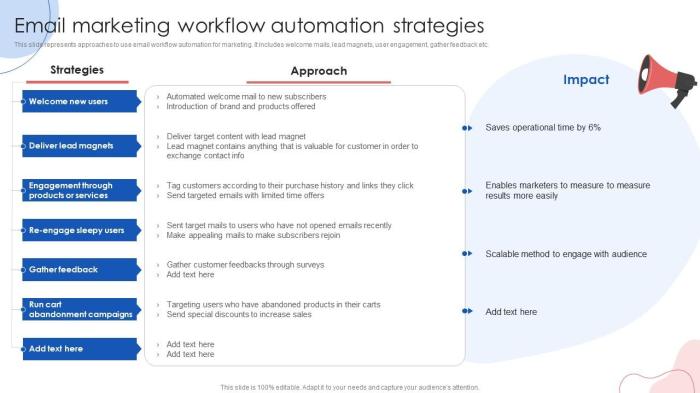
Before optimizing your marketing automation workflow, a thorough assessment of your existing system is crucial. This involves understanding its current state, identifying areas for improvement, and benchmarking its performance against industry standards. This evaluation will inform the strategic changes needed to streamline your processes and boost efficiency.
Current Marketing Automation Workflow
Let’s assume your current marketing automation workflow follows a common path. It begins with lead generation through website forms and social media campaigns. These leads are then segmented based on demographics and engagement levels using your CRM (e.g., Salesforce) and marketing automation platform (e.g., HubSpot). Automated email sequences are triggered based on these segments, nurturing leads through various stages of the sales funnel.
This involves sending welcome emails, product updates, and promotional offers. Finally, lead scoring helps prioritize high-potential leads for sales follow-up. The entire process relies on data tracking and analytics within your chosen platform to monitor performance.
Bottlenecks and Inefficiencies
Several inefficiencies might hinder your current system. For example, inconsistent lead scoring might lead to qualified leads being overlooked. Poorly segmented email lists result in irrelevant messages, decreasing engagement and harming your brand reputation. A lack of integration between your CRM and marketing automation platform can cause data silos, hindering a holistic view of customer interactions. Another common issue is a lack of A/B testing on email campaigns, preventing optimization of subject lines, content, and call-to-actions.
Finally, a cumbersome process for reporting and analyzing campaign performance may lead to delayed insights and corrective actions.
Performance Metrics and Benchmarks
Let’s assume your current email open rate is 20%, click-through rate is 5%, and conversion rate is 2%. Industry benchmarks vary significantly based on industry and audience, but a reasonable expectation might be an open rate of 25-30%, a click-through rate of 10-15%, and a conversion rate of 5-10%. This indicates room for improvement in your current system’s performance.
The discrepancy might be due to several factors identified in the previous section, such as poor segmentation or ineffective email content.
Feature Comparison of Marketing Automation Systems
The following table compares the features of your current system (hypothetically, HubSpot) with three leading competitors (Marketo, Pardot, and ActiveCampaign):
| Feature | HubSpot | Marketo | Pardot | ActiveCampaign |
|---|---|---|---|---|
| Lead Scoring | Robust, customizable scoring | Advanced scoring with predictive capabilities | Strong scoring with integration to Salesforce | User-friendly scoring with automation options |
| Email Marketing | Drag-and-drop editor, A/B testing | Advanced email features, robust segmentation | Salesforce integration, email automation | Powerful automation, segmentation, and personalization |
| CRM Integration | Native integration with HubSpot CRM | Integrates with various CRMs | Deep integration with Salesforce | Integrates with various CRMs, including Salesforce |
| Reporting & Analytics | Comprehensive dashboards and reports | Advanced analytics and reporting features | Robust reporting with Salesforce integration | User-friendly reporting with customizable dashboards |
| Pricing | Tiered pricing based on features and users | Enterprise-focused pricing | Tiered pricing with Salesforce integration costs | Tiered pricing with various plan options |
Streamlining Processes and Choosing the Right Tools
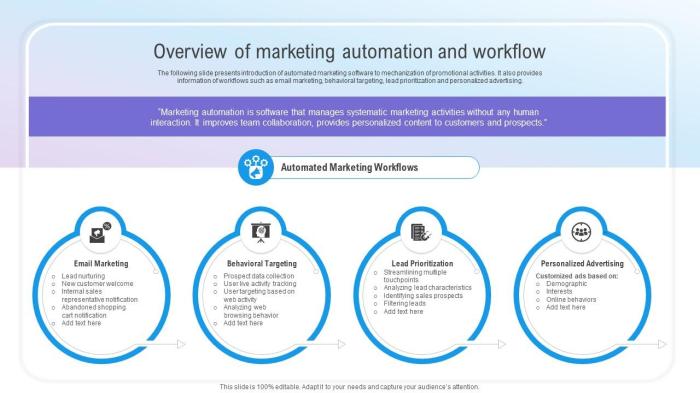
Optimizing your marketing automation workflow involves a strategic approach to process refinement and technology selection. By carefully analyzing your current system and identifying bottlenecks, you can create a more efficient and effective marketing engine. This section details how to develop a revised workflow, select the right tools, and integrate them seamlessly into your existing infrastructure.
A streamlined workflow minimizes redundancies, automates repetitive tasks, and improves overall team productivity. This leads to increased efficiency, better resource allocation, and ultimately, a higher return on investment (ROI) from your marketing efforts. The key is to identify the specific pain points in your current process and design a solution that directly addresses them.
Revised Workflow and Flowchart Illustration
A revised workflow should focus on eliminating unnecessary steps and automating repetitive tasks. Consider using a visual flowchart to map out the new process. This allows for easy identification of potential bottlenecks and ensures everyone on the team understands the updated procedures. The flowchart would depict a simplified process. For instance, instead of multiple manual approvals for email campaigns, the revised workflow might incorporate automated approval workflows based on pre-defined criteria.
Similarly, lead scoring and qualification could be automated, reducing manual intervention and speeding up the sales process. The flowchart would visually represent these improvements, showing the flow of leads through different stages, highlighting automated steps and decision points.
Imagine a flowchart with distinct boxes representing stages like “Lead Capture,” “Lead Scoring,” “Email Campaign Trigger,” “Sales Handoff,” and “Performance Analysis.” Arrows would connect these boxes, indicating the flow of leads and data. Automated steps would be clearly marked, for example, an automated email series triggered by a specific lead score. This visual representation provides a clear overview of the streamlined process and facilitates better communication and collaboration within the team.
Marketing Automation Platform Comparison
Choosing the right marketing automation platform is crucial for successful implementation. The following table compares three popular platforms – HubSpot, Marketo, and Pardot – based on pricing, features, and integrations.
| Feature | HubSpot | Marketo | Pardot |
|---|---|---|---|
| Pricing | Tiered pricing, starting with a free option and scaling up based on features and contacts. | Enterprise-focused pricing, generally higher than HubSpot and Pardot. Requires a significant investment upfront. | Tiered pricing, suitable for mid-sized businesses and enterprises. Offers a balance between cost and functionality. |
| Features | Comprehensive suite of tools including email marketing, CRM, social media management, landing pages, and analytics. | Advanced features such as account-based marketing (ABM), predictive analytics, and complex automation capabilities. | Strong focus on lead nurturing and B2B marketing, with robust lead scoring and campaign management features. |
| Integrations | Integrates with a wide range of CRM and analytics tools, including Salesforce, Google Analytics, and many others. | Offers extensive integration capabilities, but setup can be complex. Strong integration with Adobe Marketing Cloud. | Seamless integration with Salesforce, and good compatibility with other popular marketing and sales tools. |
Addressing Bottlenecks with Chosen Platform Features
Let’s assume HubSpot is selected. Its features directly address several common marketing bottlenecks. For example, its built-in CRM eliminates the need for separate CRM software, streamlining data management and improving lead tracking. The robust email marketing tools automate email campaigns, personalized messaging, and A/B testing, reducing manual effort and improving campaign performance. Finally, HubSpot’s reporting and analytics dashboards provide valuable insights into campaign effectiveness, enabling data-driven decision-making.
Integrating Chosen Platform with Existing Tools
Integrating HubSpot with existing CRM and analytics tools is straightforward. The following steps illustrate the process:
- Identify existing tools: Determine which CRM and analytics platforms are currently in use (e.g., Salesforce, Google Analytics).
- Check for native integrations: Verify if HubSpot offers native integrations with your chosen tools. HubSpot’s marketplace provides a list of compatible applications.
- Utilize API connectors: If native integrations are unavailable, explore API connectors or third-party integration tools to facilitate data exchange.
- Configure data mapping: Define how data fields will be mapped between HubSpot and your existing systems to ensure data consistency and accuracy.
- Test the integration: Thoroughly test the integration to ensure data is flowing correctly and functionalities are working as expected.
- Monitor performance: Regularly monitor the integration to identify and address any potential issues or data discrepancies.
Implementing and Optimizing the New System
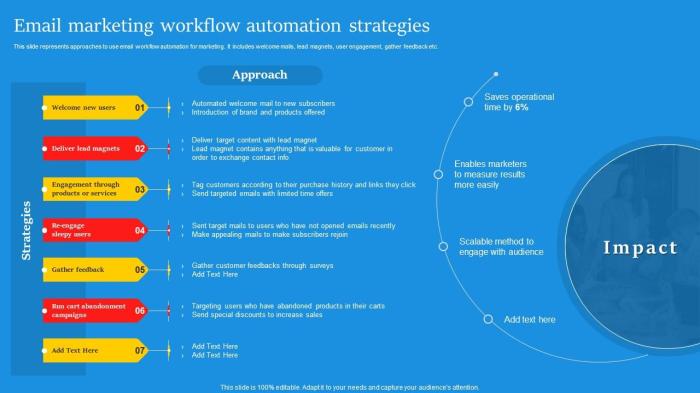
Successfully transitioning to a new marketing automation system requires careful planning and execution. A phased approach, focusing on data migration, team training, KPI monitoring, and ongoing optimization, ensures a smooth transition and maximizes the benefits of the streamlined workflow. Ignoring any of these steps can lead to delays, data loss, and ultimately, a less effective marketing strategy.
Data Migration Plan
A well-defined data migration strategy is crucial for minimizing disruption during the system changeover. This involves a thorough assessment of the existing data, cleaning and preparing it for import, and implementing a phased migration approach to reduce the risk of errors and data loss. For example, you might begin by migrating a smaller segment of your contact database to test the process before migrating the entire database.
Regular backups of both the old and new systems should be maintained throughout the process. Furthermore, a clear rollback plan should be in place in case of unforeseen issues. This might involve temporarily reverting to the old system until the problem is resolved. Detailed documentation of each step in the migration process is essential for troubleshooting and future reference.
Team Training Program
Effective training is essential for your team to successfully utilize the new marketing automation platform. The training program should be tailored to different roles and skill levels within the marketing team. Consider offering a combination of online modules, hands-on workshops, and ongoing support. For example, introductory modules could cover the platform’s basic functionalities, while advanced workshops could focus on specific features like A/B testing or workflow automation.
Regular check-ins and Q&A sessions can address any ongoing questions or challenges. Providing easily accessible documentation and cheat sheets will also assist team members in remembering key functionalities and best practices. The training should emphasize practical application and encourage experimentation within a safe testing environment.
Key Performance Indicators (KPIs)
Monitoring key performance indicators (KPIs) is critical for evaluating the success of the streamlined workflow. These metrics should be aligned with your overall marketing objectives. Examples include email open rates, click-through rates, conversion rates, customer acquisition cost (CAC), and return on investment (ROI). Regularly tracking these KPIs will allow you to identify areas for improvement and make data-driven decisions to optimize your marketing automation strategies.
It’s crucial to establish baseline metrics before implementing the new system to measure the impact of the changes. For instance, compare email open rates before and after the system change to assess the effectiveness of the new platform.
A/B Testing for Optimization
A/B testing is a powerful tool for optimizing email campaigns and other automated processes within the new marketing automation platform. This involves creating two versions of a campaign (A and B) with slight variations, such as subject lines, call-to-action buttons, or email content, and then sending each version to a segmented audience. By analyzing the results, you can identify which version performs better and refine your future campaigns based on data-driven insights.
For example, you could A/B test different subject lines to determine which one generates the highest open rate. This iterative process of testing and refinement allows for continuous improvement and maximizing the effectiveness of your automated marketing efforts. Remember to test only one variable at a time to isolate the impact of each change.
Ending Remarks

Revamping your marketing automation is a journey, not a destination. By carefully assessing your current system, selecting the right tools, and implementing a well-defined plan, you can dramatically improve efficiency and boost your marketing ROI. Remember that continuous optimization, through monitoring KPIs and A/B testing, is crucial for sustained success. Embrace the process of iterative improvement, and watch your marketing efforts flourish.