Unlocking the hidden stories within data requires more than just technical proficiency; it demands a strategic shift in how you approach analysis. This guide explores how to refine your data analysis skills, moving beyond simple data manipulation to extract truly meaningful insights. We’ll delve into powerful visualization techniques, advanced statistical methods, and efficient programming practices to transform your analytical capabilities and empower you to make data-driven decisions with confidence.
From mastering the art of data visualization to leveraging the power of Python libraries, this comprehensive journey will equip you with the tools and strategies needed to uncover actionable insights from complex datasets. We will examine how to choose the right charts for different data types, apply advanced statistical techniques like regression and hypothesis testing, and build efficient data pipelines for automated analysis.
The goal is to help you move from simply processing data to extracting knowledge that informs strategic action.
Mastering Data Visualization for Insight Extraction
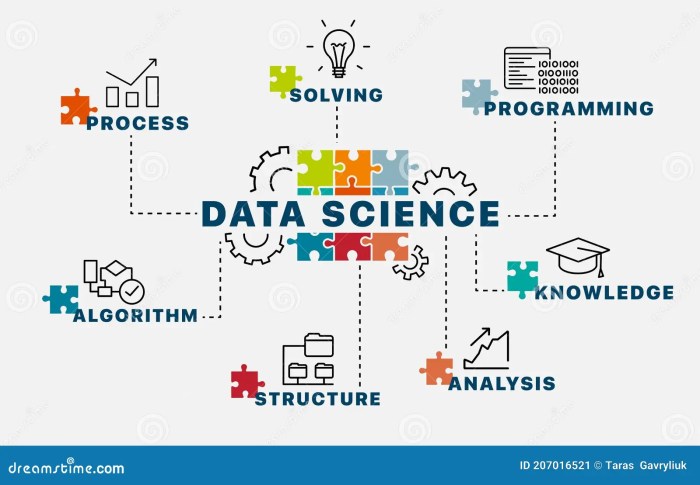
Effective data visualization is crucial for transforming raw data into actionable insights. By choosing the right chart type and employing effective visual elements, analysts can communicate complex information clearly and concisely, leading to better decision-making. This section will explore techniques for mastering data visualization to extract meaningful insights from your data.
Illustrative Charts and Their Impact on Insight Extraction
Let’s consider a hypothetical sales dataset encompassing monthly sales figures for different product categories over a two-year period. Different visualizations will reveal different aspects of this data.
| Chart Type | Data Type | Insight Revealed | Example |
|---|---|---|---|
| Bar Chart | Categorical data (product categories) and numerical data (sales figures) | Comparison of sales across different product categories for a specific time period. | A bar chart could clearly show that “Product A” consistently outperforms “Product B” each month. |
| Line Graph | Time-series data (monthly sales) | Trends and patterns in sales over time. | A line graph would illustrate the overall sales growth or decline over the two years, highlighting seasonal fluctuations. |
| Scatter Plot | Two numerical variables (e.g., advertising spend and sales) | Correlation between two variables. | A scatter plot could reveal a positive correlation between advertising expenditure and sales, suggesting that increased advertising leads to higher sales. |
| Pie Chart | Categorical data showing proportions | Proportional breakdown of sales across product categories for a specific period. | A pie chart could show the percentage contribution of each product category to the total sales in a given month. |
A Step-by-Step Guide to Selecting the Appropriate Visualization Method
Choosing the right visualization is paramount. The process should be guided by both the data type and the analytical goal.
- Identify the type of data: Is your data categorical, numerical, or a combination of both? Is it time-series data?
- Define your analytical goal: What insights are you trying to extract? Are you comparing values, showing trends, identifying correlations, or displaying proportions?
- Select the appropriate chart type: Based on your data type and analytical goal, choose the visualization that best suits your needs. For example, bar charts are ideal for comparing categories, while line graphs are suitable for showing trends over time.
- Consider your audience: Choose a visualization that is easily understandable and interpretable by your intended audience. Avoid overly complex or cluttered visualizations.
- Iterate and refine: Experiment with different visualizations and refine your choices based on the clarity and effectiveness of the insights revealed.
Enhancing Insight Extraction with Color Palettes and Chart Annotations
A well-chosen color palette and strategic annotations significantly improve data visualization’s impact.Imagine a bar chart showing sales by region. Using a color-blind-friendly palette ensures accessibility. Adding annotations, such as labels showing specific sales figures for each region or highlighting the highest-performing region with a distinct color or callout box, immediately clarifies the data and draws attention to key findings.
Similarly, using consistent color coding across multiple charts enhances understanding when comparing data across different visualizations. A visually appealing and thoughtfully designed chart is far more likely to engage the audience and lead to better comprehension of the underlying data.
Advanced Statistical Methods for Deeper Understanding
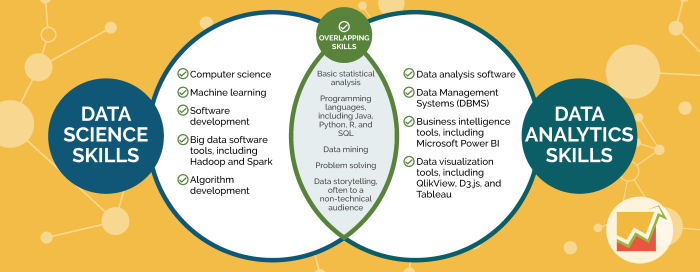
Moving beyond basic descriptive statistics, advanced methods unlock deeper insights from data. This section explores regression analysis and clustering, crucial techniques for understanding customer behavior, and demonstrates the role of hypothesis testing in validating findings. Finally, we’ll Artikel a structured approach to interpreting the results of statistical analyses.
Regression Analysis and Clustering in Customer Behavior Analysis
Regression analysis and clustering are powerful tools for uncovering patterns in customer behavior data. Regression helps predict a dependent variable (like customer lifetime value) based on independent variables (like age, purchase frequency, and location). Clustering, conversely, groups similar customers together based on shared characteristics, revealing distinct segments within the customer base.Regression analysis, for example, might model the relationship between customer spending and marketing campaign engagement.
By identifying significant predictors, businesses can optimize marketing strategies and personalize offers. Imagine a model predicting customer churn based on factors like average order value and customer service interaction frequency. This enables proactive interventions to retain valuable customers.Clustering techniques, on the other hand, could segment customers into groups based on purchasing patterns or demographics. One cluster might represent high-value, frequent buyers, while another might consist of price-sensitive customers.
This segmentation allows for targeted marketing campaigns and product development efforts. For instance, a retailer might identify a cluster of customers who consistently purchase organic products and tailor their marketing to emphasize sustainability.
Hypothesis Testing for Insight Validation
Hypothesis testing provides a framework for objectively evaluating insights derived from data analysis. It allows us to determine the statistical significance of observed patterns, ensuring they aren’t simply due to random chance.The steps involved in conducting a hypothesis test are Artikeld below:
| Step | Description |
|---|---|
| 1. Formulate Hypotheses | State the null hypothesis (H0), representing no effect or relationship, and the alternative hypothesis (H1), representing the effect or relationship you suspect. |
| 2. Set Significance Level (α) | Choose a significance level (e.g., 0.05), representing the probability of rejecting the null hypothesis when it’s actually true (Type I error). |
| 3. Select Test Statistic | Choose an appropriate statistical test based on the data type and hypotheses (e.g., t-test, chi-square test, ANOVA). |
| 4. Collect and Analyze Data | Gather the necessary data and perform the chosen statistical test. |
| 5. Calculate p-value | Determine the p-value, the probability of observing the obtained results (or more extreme results) if the null hypothesis were true. |
| 6. Make a Decision | Compare the p-value to the significance level. If the p-value is less than α, reject the null hypothesis; otherwise, fail to reject the null hypothesis. |
Interpreting Statistical Analysis Results
Interpreting the results of a statistical analysis requires a systematic approach to identify key trends and patterns.
1. Understand the context
Begin by reviewing the research question and the data used in the analysis. This ensures the results are interpreted within the appropriate context.
2. Examine descriptive statistics
Start by examining descriptive statistics (mean, median, standard deviation, etc.) to get an overall sense of the data distribution. This provides a baseline understanding before diving into more complex analyses.
3. Analyze inferential statistics
Focus on the key results of the inferential statistical tests (p-values, confidence intervals, effect sizes). These indicate the statistical significance and practical importance of the findings.
4. Visualize the results
Use appropriate visualizations (charts, graphs) to present the results in a clear and concise manner. Visualizations make it easier to identify patterns and trends.
5. Draw conclusions
Based on the descriptive and inferential statistics and visualizations, draw conclusions about the research question. Clearly state the findings and their implications.
6. Consider limitations
Acknowledge any limitations of the analysis, such as sample size, data quality, or assumptions made during the analysis. This provides a balanced and nuanced interpretation of the results.
Leveraging Programming for Efficient Insight Generation

Harnessing the power of programming significantly enhances the speed and accuracy of data analysis, allowing for the extraction of meaningful insights that might otherwise be missed or obscured within large datasets. By automating tasks and applying sophisticated analytical techniques, we can uncover patterns and trends more efficiently, leading to better decision-making. This section focuses on utilizing Python and its powerful libraries to achieve this.
Python Libraries for Data Analysis
Python, with its rich ecosystem of libraries, provides a robust framework for data manipulation and analysis. Pandas, NumPy, and Matplotlib are particularly valuable tools for cleaning, transforming, and visualizing financial transaction data. Let’s illustrate this with a hypothetical dataset of financial transactions. Imagine a CSV file containing columns for transaction date, amount, type (e.g., debit, credit), and category (e.g., food, rent, entertainment).
import pandas as pd
import numpy as np
import matplotlib.pyplot as plt

# Load the dataset
data = pd.read_csv('financial_transactions.csv')

# Data Cleaning (example: handling missing values)
data.fillna(0, inplace=True) # Replace missing values with 0

# Data Transformation (example: creating a new column for transaction month)
data['TransactionMonth'] = pd.to_datetime(data['TransactionDate']).dt.to_period('M')

# Data Analysis (example: calculating monthly spending per category)
monthly_spending = data.groupby(['TransactionMonth', 'Category'])['Amount'].sum().unstack()

# Data Visualization (example: plotting monthly spending)
monthly_spending.plot(kind='bar', figsize=(10, 6))
plt.title('Monthly Spending by Category')
plt.xlabel('Month')
plt.ylabel('Amount')
plt.legend(title='Category')
plt.show()

# Key Performance Indicator (KPI) Calculation (example: total monthly spending)
total_monthly_spending = monthly_spending.sum(axis=1)
print(total_monthly_spending)
This code snippet demonstrates how to load, clean, transform, analyze, and visualize financial transaction data using Pandas, NumPy, and Matplotlib. The calculated total monthly spending serves as a key performance indicator. Note that this is a simplified example; real-world scenarios often require more complex data cleaning and transformation steps.
Building a Data Pipeline for ETL
Automating the data extraction, transformation, and loading (ETL) process is crucial for efficient data analysis. A well-structured data pipeline ensures data consistency, reduces manual errors, and enables faster insight generation. The following steps Artikel a typical ETL pipeline:
A robust data pipeline ensures consistent, reliable data for analysis, reducing manual effort and increasing efficiency.
- Extraction: This stage involves retrieving data from various sources. This could include databases (SQL, NoSQL), APIs, CSV files, or other data storage systems. The choice of extraction method depends on the data source and its format.
- Transformation: This is where data cleaning, transformation, and enrichment occur. This may involve handling missing values, converting data types, standardizing formats, and creating new features. Techniques like data normalization, aggregation, and feature engineering are often employed.
- Loading: The transformed data is then loaded into a target system, such as a data warehouse, data lake, or a database. This stage ensures that the data is readily available for analysis and reporting. The loading method depends on the target system’s requirements.
Comparative Analysis of Data Manipulation Techniques
Different data manipulation techniques offer varying levels of efficiency and suitability depending on the data type and the desired outcome. The following table compares several techniques in Python, focusing on their efficiency and suitability for various data types:
Understanding the strengths and weaknesses of different data manipulation techniques allows for optimized data processing.
| Technique | Data Type | Efficiency | Suitability | Example (Python) |
|---|---|---|---|---|
| Pandas `apply()` | Various | Moderate (can be slow for large datasets) | General purpose, flexible | df['new_column'] = df['column'].apply(lambda x: x - 2) |
| NumPy vectorized operations | Numeric arrays | High | Efficient for numerical computations | result = np.array(df['column']) - 2 |
| List comprehensions | Lists | High (for smaller datasets) | Concise, readable | new_list = [x
|
| Pandas `groupby()` | Various | Moderate to High (depending on grouping complexity) | Aggregation and summarization | grouped = df.groupby('category')['amount'].sum() |
This table highlights that NumPy vectorized operations are generally the most efficient for numerical data, while Pandas provides flexible tools for various data types and operations. The choice of technique depends on the specific needs of the analysis.
Ultimate Conclusion
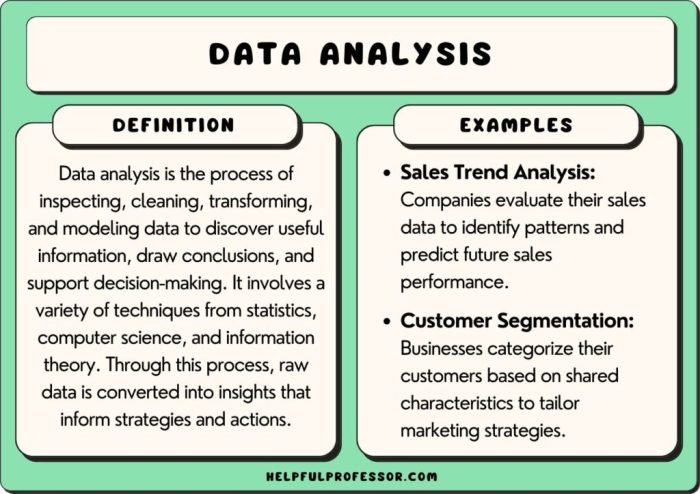
By mastering data visualization, employing advanced statistical methods, and leveraging the power of programming, you can significantly enhance your ability to extract valuable insights from data. This guide has provided a framework for refining your analytical skills, moving beyond basic data manipulation to uncover actionable intelligence. Remember, the journey of data analysis is continuous; constant learning and adaptation are key to staying ahead of the curve and extracting ever more profound insights from the ever-growing volume of data available to us.
Embrace the challenge, and the rewards will be significant.